Roughly two weeks of independent travel in Japan, with a final net expenditure of CNY 12,981.20 after tax refunds.This report analyses 77 ledger entries and uses a unified debit-credit reconciliation to show where the money went, how it was paid, and how much was saved. Transportation accounted for nearly 40% of recorded spending, the ten largest transactions made up about two-thirds of the total, and discounts plus tax refunds saved CNY 238.94.
Source: attached sheet on this page
- Notes: all amounts are in Chinese yuan (CNY), rounded to 2 decimals; exchange rates to 5 decimals; round-half-up throughout. Discounts are shown as negative numbers ("money saved") and already fold in per-item discounts, card-voucher rebates and bank cashback in one column. The cash purchase is recorded in the table; the tax refund sits outside the table and is analysed in Sections 8–9.
1. Overview
The trip logged spending on 14 days. In detail there are 77 entries: 73 ordinary purchases plus 4 discount/cashback adjustments, with 1 cash purchase already merged into the ordinary entries.
The ledger (CNY)
| Item | Amount (CNY) |
|---|---|
| Gross spending (before discounts/adjustments) | 13,220.14 |
| Discounts & adjustments in-table | −113.99 |
| Net paid in-table | 13,106.15 |
| Tax refund received | −124.95 |
| Net spend after refund | 12,981.20 |
Net spend after refund averages CNY 927.23 per day; net paid in-table averages CNY 936.15 per day. Both are taken over the 14 days that have records.
Notes: the CNY 113.99 of in-table discounts/adjustments breaks down as per-item discounts CNY 13.76 + card-voucher rebates CNY 80.00 + bank cashback CNY 20.23. Two tax refunds totalling CNY 124.95 arrived separately and are accounted for outside the table. Hence net spend after refund = CNY 13,106.15 − CNY 124.95 = CNY 12,981.20.
Where it went: transport (flights, Shinkansen, Suica top-ups and the like) leads at 37.1%; shopping 23.7%, dining 18.9%, lodging 15.1%; entertainment, telecom and insurance together are about 5.3%.
How it was paid: mostly by card (ABC for big tickets, SPD for everyday spend, CGB as backup); cash was just 4.7% of net paid. The channel pattern is "big items booked online (OTA averages CNY 1,110.61 per booking) versus small daily spend in person (in-store averages CNY 132.99)."
Savings from discounts and tax refunds: CNY 238.94 in total, equivalent to 1.8% of gross spending. In other words, for every CNY 100 of gross spending, approximately CNY 1.80 was saved through discounts, vouchers, cashback and tax refunds.
Bottom line: spending is concentrated in a few large, front-loaded purchases and otherwise spread thinly across daily life; the 10 largest transactions account for 65.4% of net paid, so controlling the big items controls the budget.
2. Ledger reconciliation & tax-refund adjustment
This section keeps a debit-credit balance in view while folding "point 1 · in-table spending check" and "point 2 · tax-refund adjustment" into one set of accounts, making the correspondence, the debit/credit direction and the balancing rule explicit. The governing identity is every debit has a matching credit, and total debits equal total credits (used purely for reconciliation — this is not a full set of accounting books).
2.1 Accounts and debit/credit direction (for reconciliation)
| Acct | Name | Type | Debit/Credit rule | Corresponds to |
|---|---|---|---|---|
| 6001 | Gross spending before discounts | Expense | Debit increases | Gross spending CNY 13,220.14 |
| 6002 | Discounts | Contra-expense | Credit increases | In-table discounts/adjustments CNY 113.99 |
| 6003 | Tax-refund income | Contra-expense | Credit increases | Tax refund received CNY 124.95 |
| 1002 | Payment assets (simplified) | Asset | Debit increases | Actual payments and refund inflow |
2.2 Ledger entries (in-table spending + tax-refund adjustment)
Entry ① (point 1 · in-table spending check)
Dr  Gross spending before discounts (6001)     13,220.14
    Cr  Payments made (1002)             13,106.15
    Cr  Discounts (6002)                           113.99
Balanced: CNY 13,220.14 = CNY 13,106.15 + CNY 113.99, i.e. "gross spending − discounts = net paid in-table".
Entry ② (point 2 · tax-refund adjustment)
Dr  Tax refunds received (1002)            124.95
    Cr  Tax-refund income (6003)                   124.95
Balanced: the debit "Tax refunds received" CNY 124.95 equals the credit "tax-refund income" CNY 124.95. Net spend after refund is derived separately as net paid minus refund received: CNY 13,106.15 − CNY 124.95 = CNY 12,981.20.
2.3 Summary debit-credit reconciliation (debits = credits check)
| Account | Debit (CNY) | Credit (CNY) |
|---|---|---|
| Gross spending before discounts (6001) | 13,220.14 | |
| Discounts (6002) | 113.99 | |
| Tax-refund income (6003) | 124.95 | |
| Payments made (1002) | 13,106.15 | |
| Tax refunds received (1002) | 124.95 | |
| Total | 13,345.09 | 13,345.09 |
Total debits = total credits = CNY 13,345.09, so the ledger balances.
2.4 Correspondence and net-amount derivation
- Net cash outflow = paid CNY 13,106.15 − refund received CNY 124.95 = CNY 12,981.20 (net reduction in payment assets).
- Net expense = gross spending CNY 13,220.14 − discounts CNY 113.99 − refund income CNY 124.95 = CNY 12,981.20 (net on the expense side).
- The two net figures are equal (both CNY 12,981.20), confirming the relationship: net spend after refund = net paid in-table − tax refund received (i.e. CNY 13,106.15 − CNY 124.95 = CNY 12,981.20). The "net paid" of point 1 and the "net spend after refund" of point 2 connect directly through account 1002 (bank/card) and account 6003 (refund income).
3. Spending by category
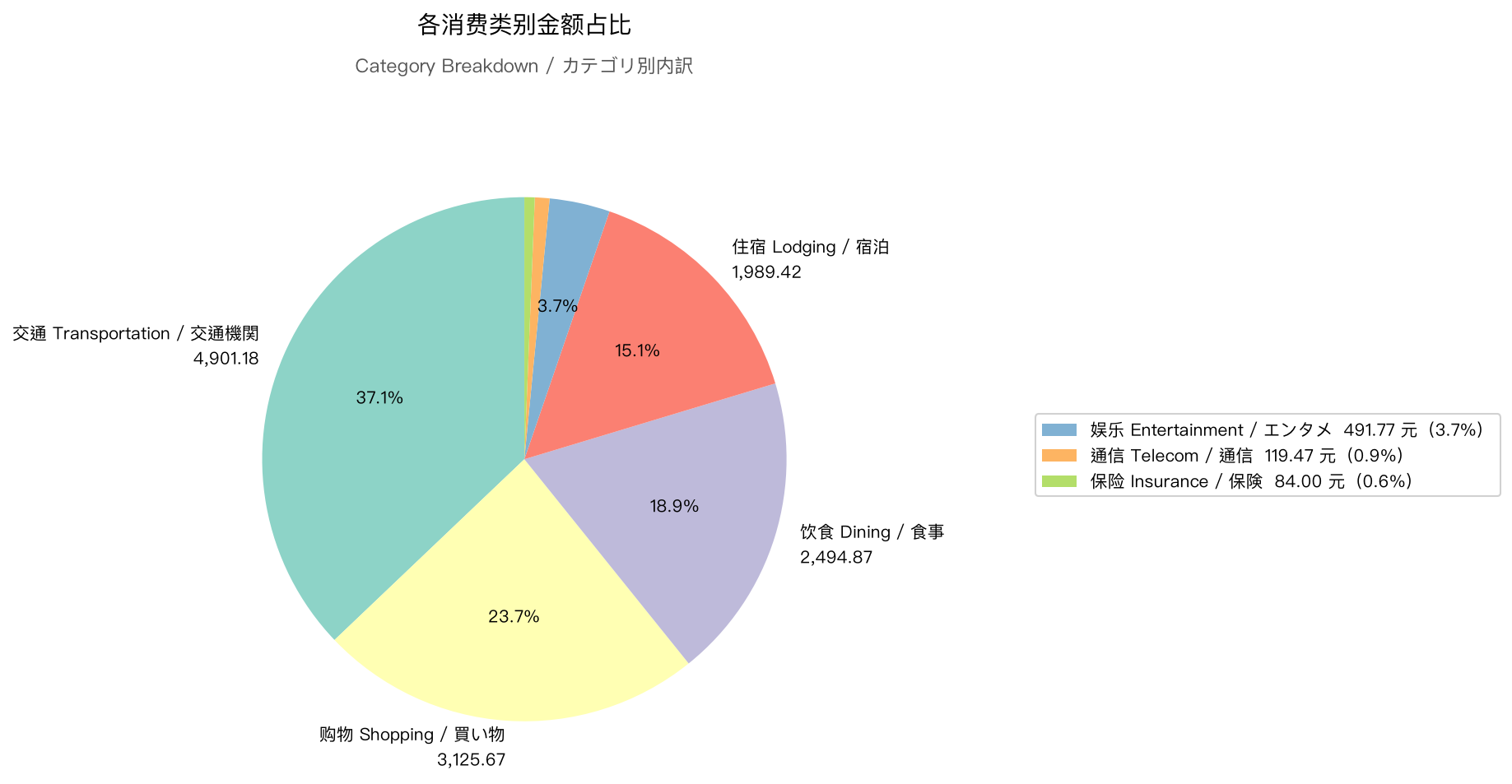
| Category | Amount (CNY) | Share |
|---|---|---|
| Transportation | 4,901.18 | 37.1% |
| Shopping | 3,125.67 | 23.7% |
| Dining | 2,494.87 | 18.9% |
| Lodging | 1,989.42 | 15.1% |
| Entertainment | 491.77 | 3.7% |
| Telecom | 119.47 | 0.9% |
| Insurance | 84.00 | 0.6% |
This table is the amount actually paid across the 73 ordinary purchases (per-item small discounts already deducted; the 4 voucher/cashback adjustments excluded), totalling CNY 13,206.38. Note that the category amounts sum to CNY 13,206.38, which is not the same as net paid in-table CNY 13,106.15 — the 4 voucher/cashback adjustments (vouchers CNY 80.00 + cashback CNY 20.23 = CNY 100.23) must still be deducted: CNY 13,206.38 − CNY 100.23 = CNY 13,106.15 (consistent with Section 2).
What was actually bought in each category (three largest items by value)
| Category | Entries | Top three | Top-3 total (CNY) | Share of category |
|---|---|---|---|---|
| Transportation | 15 | Round-trip flight Chengdu–Tokyo; Shinkansen Shin-Osaka–Tokyo; Shinkansen Shin-Yokohama–Shin-Osaka | 4,135.84 | 84.4% |
| Shopping | 9 | Montbell clothing (Osaka); 2 Montbell short-sleeves (Ginza); heat-not-burn tobacco (Narita duty-free) | 2,269.27 | 72.6% |
| Dining | 37 | JPY 15,000 cash (general); grilled-beef dinner (Fujisawa); Mt. Fuji tour lunch | 959.58 | 38.5% |
| Lodging | 7 | Tokyo 3 nights (Aug 4–7); Tokyo 2 nights (Aug 11–13); Osaka 2 nights (Aug 8–10) | 1,538.80 | 77.3% |
| Entertainment | 3 | Mt. Fuji day tour (Aug 12); Shibuya Sky admission; Shibuya Sky paid photo | 491.77 | 100.0% |
| Telecom | 1 | KDDI Japan unlimited-data SIM | 119.47 | 100.0% |
| Insurance | 1 | Japan travel insurance | 84.00 | 100.0% |
- Transportation (CNY 4,901.18, 37.1%): the single largest item is the Chengdu–Tokyo round trip at CNY 2,921.50, 59.6% of the category; of the remaining CNY 1,979.68, the two Shinkansen legs account for CNY 1,214.34 and the rest is Suica top-ups and local/arrival transport. In other words, the high transport share is driven almost entirely by the one flight; everyday local transport was not expensive. Note: Suica top-ups are not all spent on transit (convenience stores and airport buses also draw on it); the source records don't split this, so it stays under the current booking category.
- Shopping (CNY 3,125.67, 23.7%): the largest single item is the Montbell clothing purchase in Osaka; see the table above for top-three concentration. Two Montbell purchases (Ginza and Osaka) generated tax refunds — see Section 8.
- Dining (CNY 2,494.87, 18.9%): includes one cash purchase of CNY 622.14 (24.9% of the category), shown on its own line (the cash is booked as a merged entry under dining and is not split by receipt); the largest card item is the grilled-beef dinner in Fujisawa at CNY 169.23. The cash is the part of the JPY 15,000 brought from home that was actually spent, recorded faithfully in the detail.
- Lodging (CNY 1,989.42, 15.1%): the largest single item is the 3 Tokyo nights (Aug 4–7); few but large bookings, typical of the "book several nights at once" pattern.
- Entertainment (CNY 491.77) / Telecom (CNY 119.47) / Insurance (CNY 84.00): the three small items together are under CNY 700; telecom is a SIM bought once for the whole trip, insurance a one-off, and entertainment mostly tickets and small add-ons.
4. Daily spending rhythm
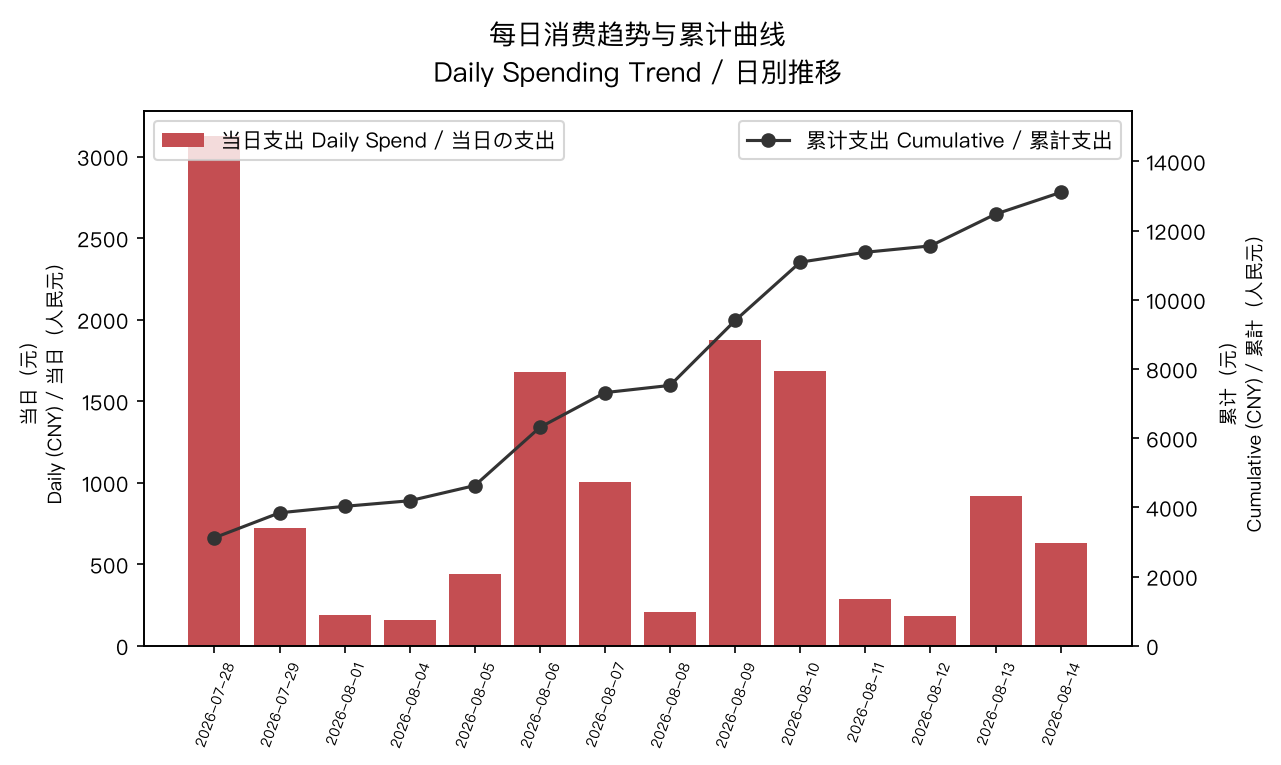
| Date | Entries | Daily (CNY) | Cumulative (CNY) |
|---|---|---|---|
| 2026-07-28 | 3 | 3,124.97 | 3,124.97 |
| 2026-07-29 | 1 | 720.82 | 3,845.79 |
| 2026-08-01 | 2 | 187.09 | 4,032.88 |
| 2026-08-04 | 4 | 161.04 | 4,193.92 |
| 2026-08-05 | 11 | 439.22 | 4,633.14 |
| 2026-08-06 | 10 | 1,682.35 | 6,315.49 |
| 2026-08-07 | 9 | 1,004.40 | 7,319.89 |
| 2026-08-08 | 5 | 208.25 | 7,528.14 |
| 2026-08-09 | 6 | 1,875.97 | 9,404.11 |
| 2026-08-10 | 9 | 1,686.40 | 11,090.51 |
| 2026-08-11 | 5 | 285.50 | 11,376.01 |
| 2026-08-12 | 2 | 184.18 | 11,560.19 |
| 2026-08-13 | 7 | 918.19 | 12,478.38 |
| 2026-08-14 | 3 | 627.78 | 13,106.16 |
Each daily figure is that day's records summed and then rounded (round-half-up); the cumulative column is a running sum of the daily figures. The 14 days sum to CNY 13,106.16; because Aug 5 and Aug 9 each contain a half-cent (x.xx5) yen-conversion record that is rounded independently per day, this is CNY 0.01 more than the ledger figure of CNY 13,106.15 (which rounds once after summing all raw values). The CNY 0.01 is a rounding artefact; the ledger figure of CNY 13,106.15 stands.
- Peak day: 2026-07-28 at CNY 3,124.97, the largest single item being the Chengdu–Tokyo round trip. Departure day settled flights, SIM and insurance in one go, jumping the cumulative curve from 0 to nearly CNY 3,100.
- Top three days: 2026-07-28 (CNY 3,124.97), 2026-08-09 (CNY 1,875.97) and 2026-08-10 (CNY 1,686.40), together CNY 6,687.34, or 51.0% of net paid in-table (CNY 13,106.15). This shows that spending was concentrated in a few high-cost days rather than evenly distributed throughout the trip. The departure-day total was driven by the flight, SIM card and insurance, while the later peaks reflected major transport, shopping and lodging expenses.
- Lightest day: 2026-08-04 at just CNY 161.04, all small outlays for meals, taxis and transit top-ups, with no large purchase (a transfer day with only basic costs).
- Overall rhythm: departure day (Jul 28) settled flights + SIM + insurance at once; Jul 29 added 3 Tokyo nights (CNY 720.82); the middle stretch (Aug 6–10) saw a wave of Shinkansen + shopping + lodging; the tail (Aug 13–14) still had CNY 600–950 of closing spend (souvenirs, the last night, etc.), so leaving is when spending tends to tick back up.
5. How it was paid
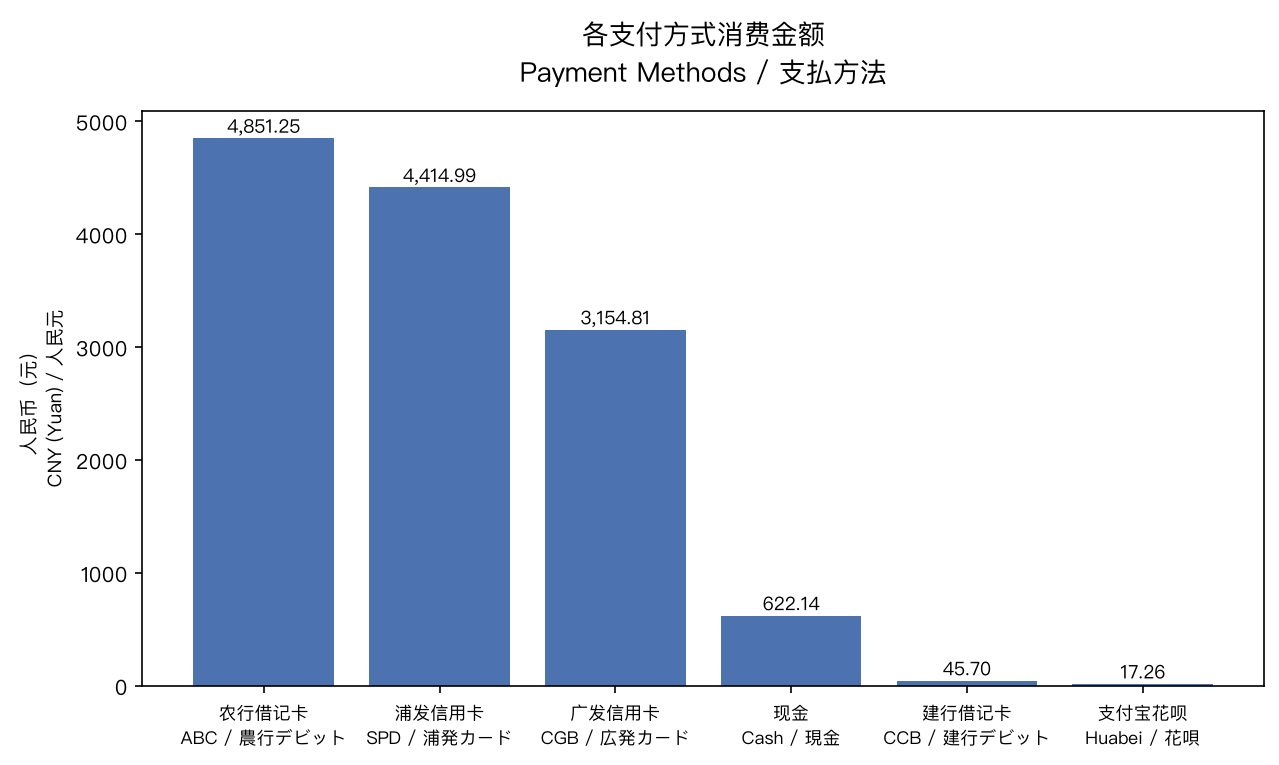
| Payment method | Entries | Amount (CNY, net) | Average per entry (CNY) |
|---|---|---|---|
| ABC Debit | 28 | 4,851.25 | 173.26 |
| SPD Credit | 33 | 4,414.99 | 133.79 |
| CGB Credit | 13 | 3,154.81 | 242.68 |
| Cash | 1 | 622.14 | 622.14 |
| CCB Debit | 1 | 45.70 | 45.70 |
| Huabei (Alipay) | 1 | 17.26 | 17.26 |
Entry counts include the 4 voucher/cashback adjustments (not independent purchases), so the payment methods total 77 entries rather than 77 independent purchases; each card's net figure already has its matching adjustments deducted.
- ABC Debit: 28 entries, CNY 4,851.25 in total, averaging CNY 173.26 — the largest method by amount. Big-ticket OTA orders such as flights and the Mt. Fuji day tour went through it, and Suica top-ups were mostly on it too.
- SPD Credit: CNY 4,414.99 net (CNY 4,515.22 of positive spending minus CNY 100.23 of voucher + cashback adjustments) — the workhorse by entry count, handling everyday food, shopping and transport, and where most of the discounts came from.
- CGB Credit: CNY 3,154.81, taking a share as the third card; CCB and Huabei were only for occasional small amounts.
- Cash: CNY 622.14 (JPY 15,000, shown at a rounded rate of 0.04148 CNY/JPY ), just 4.7% of net paid in-table — very much a "cards first, cash as backup" trip. See Section 9.
- Total CNY 13,106.15 (voucher and cashback adjustments included, matching net paid in-table).
6. Where things were bought
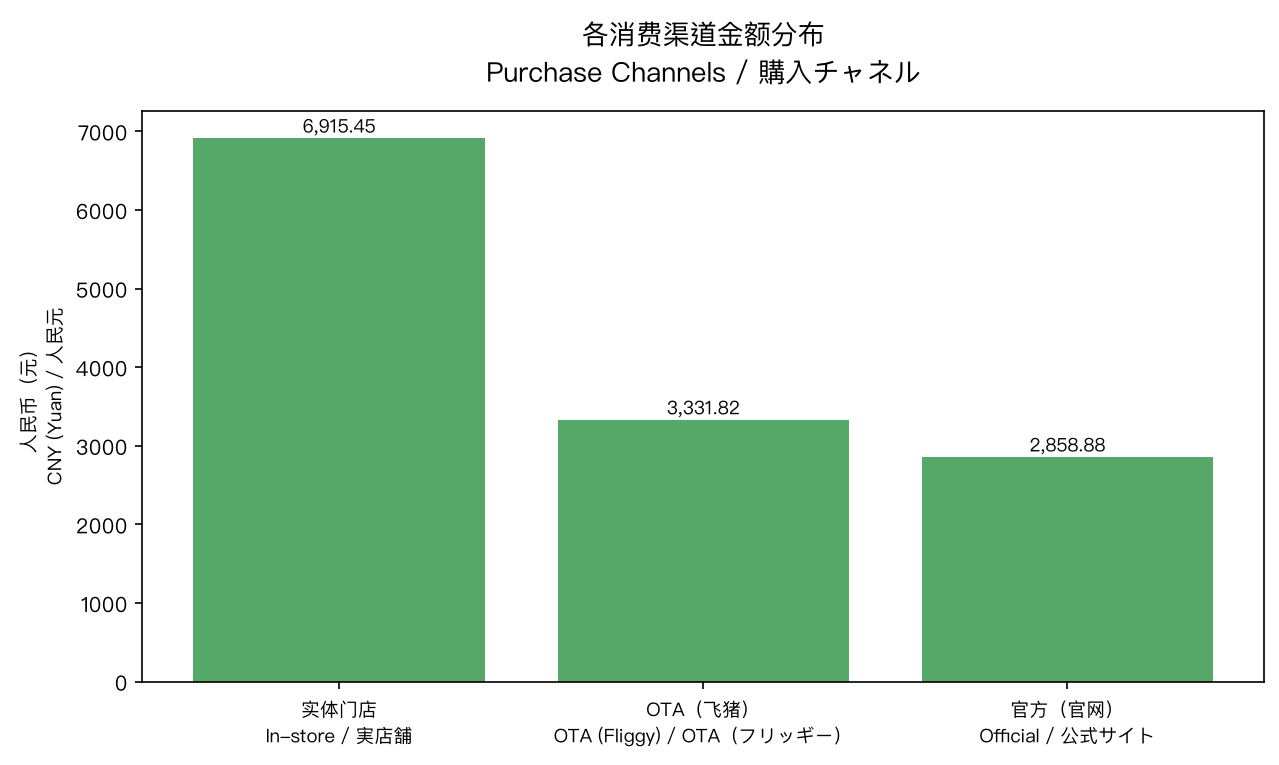
| Channel | Entries | Amount (CNY, net) | Average per entry (CNY) |
|---|---|---|---|
| In-store | 52 | 6,915.45 | 132.99 |
| OTA (Fliggy) | 3 | 3,331.82 | 1,110.61 |
| Official site | 22 | 2,858.88 | 129.95 |
Entry counts include the 4 voucher/cashback adjustments (not independent purchases), so the channels total 77 entries rather than 77 independent purchases.
- In-store (52.8%): 52 entries averaging CNY 132.99 — including purchases at convenience stores, drugstores and restaurants, as well as tax refunds on shopping-mall purchases. This channel has the highest number of entries and is the main setting for everyday spending.
- OTA / Fliggy (25.4%): 3 entries averaging CNY 1,110.61 — flights, the data SIM and the day tour booked online; fewest entries but the largest per item, the second-biggest source by amount.
- Official site (21.8%): 22 entries averaging CNY 129.95 — mostly hotels, Shinkansen and tickets booked on official sites (the average is net amount ÷ entry count and includes the adjustment entries).
- Total is likewise net paid in-table, CNY 13,106.15. In short: big items online, small spend in person — the distinction between online bookings and in-store spending is clear.
7. Top 10 transactions
These 10 total CNY 8,569.26, or 65.4% of net paid in-table — the top 10 are about 13.7% of the 73 ordinary purchases, yet account for 65.4% of the amount; controlling the big items controls the budget.
| # | Date | Item | Category | Payment | Paid (CNY) |
|---|---|---|---|---|---|
| 1 | 2026-07-28 | Round-trip flight Chengdu–Tokyo | Transportation | ABC Debit | 2,921.50 |
| 2 | 2026-08-09 | Montbell clothing (Osaka) | Shopping | CGB Credit | 1,672.57 |
| 3 | 2026-07-29 | Tokyo hotel, 3 nights (Aug 4–7) | Lodging | SPD Credit | 720.82 |
| 4 | 2026-08-10 | Shinkansen Shin-Osaka–Tokyo | Transportation | SPD Credit | 634.09 |
| 5 | 2026-08-14 | JPY 15,000 cash (mostly food & shopping) | Dining | Cash | 622.14 |
| 6 | 2026-08-07 | Shinkansen Shin-Yokohama–Shin-Osaka | Transportation | SPD Credit | 580.25 |
| 7 | 2026-08-10 | Tokyo hotel, 2 nights (Aug 11–13) | Lodging | CGB Credit | 415.84 |
| 8 | 2026-08-06 | Osaka hotel, 2 nights (Aug 8–10) | Lodging | SPD Credit | 402.14 |
| 9 | 2026-08-06 | 2 Montbell short-sleeves (Ginza) | Shopping | SPD Credit | 309.06 |
| 10 | 2026-08-10 | Mt. Fuji day tour (Aug 12) | Entertainment | ABC Debit | 290.85 |
8. Discounts and tax refunds — total saved
| Item | Amount (CNY) | Detail |
|---|---|---|
| Per-item discounts | 13.76 | 17 entries, deducted at checkout |
| Card vouchers | 80.00 | voucher rebates (3 adjustments) |
| Bank cashback | 20.23 | cashback received (1 adjustment) |
| Tax refund | 124.95 | Ginza Montbell 19.39 + Osaka Montbell 105.56, received |
| Total saved | 238.94 | 1.8% of gross spending |
The CNY 113.99 of discounts is already credited to "Discounts" in Entry ① of Section 2 and deducted from gross spending; the CNY 124.95 tax refund is an out-of-table inflow, credited to "Tax-refund income" in Entry ② and used to offset cost. Together they come to CNY 238.94, or 1.8% of gross spending — measured as discounts-plus-refunds against gross spending, about CNY 1.80 saved per CNY 100. The share is modest, but the voucher and cashback are money saved on spending that was happening anyway, and the tax refund is a benefit available on eligible shopping; both Montbell refunds arrived successfully.
| Date | Item | Refund (CNY) |
|---|---|---|
| 2026-08-06 | 2 Montbell short-sleeves (Ginza) | 19.39 |
| 2026-08-09 | Montbell clothing (Osaka) | 105.56 |
| Total | 124.95 |
9. Cash usage
- JPY 20,000 cash was brought along, of which JPY 15,000 actually spent is recorded as CNY 622.14 (2026-08-14, under "Dining", paid in cash, in-store).
- Cash is only 4.7% of net paid in-table — a very card-dependent trip, with cash essentially as a fallback.
- On the rate: the CNY figure for the JPY 15,000 is the CNY 622.14 actually recorded; back-solving gives an implied rate of 622.14 ÷ 15,000 ≈ 0.041476, shown rounded as 0.04148 CNY/JPY. Multiplying by the displayed rate (15,000 × 0.04148 = 622.20) overshoots by about CNY 0.06 purely because the displayed rate is rounded; the booked amount matches the original exchange record and needs no adjustment.
- About JPY 5,000 remained after the trip (roughly CNY 207 at the implied exchange rate), as noted in the remarks.
- On splitting the cash by receipt: the JPY 15,000 is booked as a single line under dining; for a finer category split it could be broken down by receipt, but the amount is small and has limited effect on the overall structure.
10. Exchange-rate impact
- Yen-denominated transactions carry a weighted-average rate of about 0.04260 (sum of CNY paid ÷ sum of JPY, including the cash line).
- Per-item rates sit roughly between 0.04107 and 0.04353 (four legacy anomalous/blank rate cells in the source — r19, r20, r21 and the blank r74 — are excluded; they don't affect the amounts because the CNY figures are recorded directly rather than recomputed from the rate cells).
- In practical terms: the yen transactions here show a fair spread of rates, and the exact effect on the total depends on each transaction's amount and settlement rate, so it can't be boiled down to a single fixed figure. What really matters for the wallet is when you exchange, but card spending is usually converted at the rate and settlement rules applied by the card network and issuer, which is outside the cardholder's control, so there's no need to overthink it.
11. Takeaways
- Structure: transport (flights) + lodging + shopping together make up about 76% of total spending, reflecting a mix of a few large transactions and relatively modest day-to-day expenses. Dining already includes the recorded cash expenditure, so the overall spending picture is reasonably complete.
- Payment: the "ABC for big tickets + SPD for everyday + CGB as backup" split worked cleanly, and the vouchers and cashback were all applied; concentrating large purchases on whichever card gives the best cashback/discount is worth continuing.
- Cash: cash usage was under 5%, so less cash next time means less exchanging and coin-counting (the ~JPY 5,000 left over needs handling after returning or can be kept for the next trip).
- Tax refunds: Both Montbell refunds were received successfully. Where practical, grouping eligible purchases at the same retailer may simplify the refund process and help meet any applicable minimum-purchase threshold.
- Bookkeeping: 77 entries over 14 spending days is already a fine level of detail; keeping the habit of "discounts as negatives, repayments/adjustments on their own lines" makes the books self-checkable, and the reconciliation in Section 2 is a direct roll-up of the detail table.
この記事をシェア

コメント0
まだコメントはありません。最初の一本を。